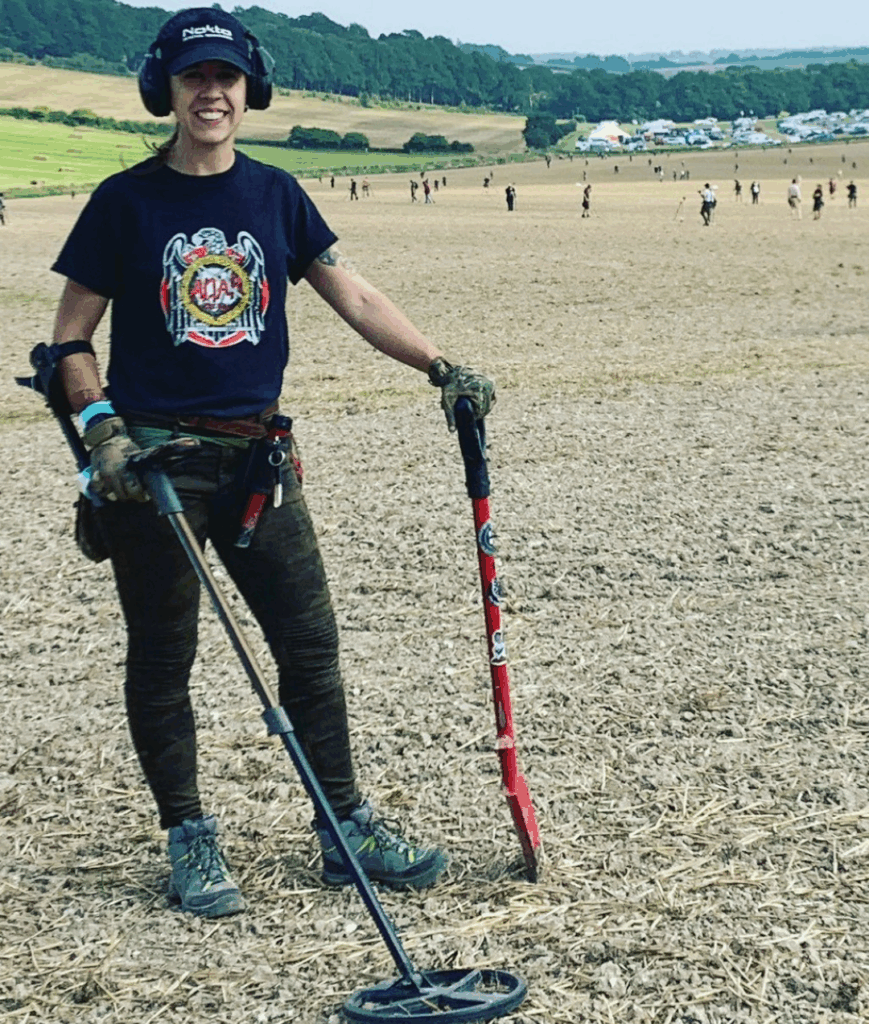
You may have heard of self recording and wondered what it was, or even how you could become a self recorder yourself. We featured Emma Youell in our last Digging Deep, talking about why she does it and how she got involved.
How did you become a self-recorder?
When I first became a detectorist in 2014, I found some Roman and hammered coins. I was told to take them to the FLO, and they could record them onto the Portable Antiquities Scheme, tell me the age and ruler on the coins. I followed this advice, but the thing was, I love the research and story behind my findings, so I wanted to research and identify the coins myself, with guidance if I needed it.
It took me a couple of months of asking my local FLO to ‘onboard’ me as a self-recorder. I then attended the recording ‘lessons’ that the Past-explorers lottery-funded scheme offered to help teach people to use the database. Unfortunately, the lottery-funded scheme has ended, but there are still valuable guides in the database for learning how to use it.
Why do you self-record?
Well, when I first find an item, I enjoy the excitement of discovering it, taking it out of the ground, and enjoying it afterwards (so long as it is not Treasure being acquired by a museum, etc.) By self-recording, I get to continue sharing my findings on the database for everyone else to enjoy and hopefully form some part of future research. I am proud to see my items within the database. I love using the database to compare my finds to those already on the database.
I was also once lucky enough to find some incredibly detailed ‘hearthstones’ (bricks surrounding a fireplace) dated 1567, which were the first type of these items on the database. Now their find spot is recorded with an explanation, and I researched them myself. This led me to find examples of the same in a German-published book, which I subsequently ordered to continue my research.
How I record finds
Different forms are generated for you to fill out, depending on what you will be recording: for example, a coin or an artefact. For example, by telling the database you are recording a coin, an additional information box becomes available for you to input all the numismatic information, such as Ruler/
Issuer, mint, inscription, etc.; the artefact form will not give you the option to input numismatic information. But in all records forms, you will need to put a description, measurements, date range and material and a find spot location – the find spot remains hidden from all members of the public.
During 2023, 108 active self-recorders were using the PAS database, of which eleven are from Kent, of which I am one. Herefordshire and Shropshire had the most active recorders, with eighteen people, but Kent was the most active regarding records produced on the database. Go, Kent! The 2024 stats are still to come …
You will also be delighted to hear that the PAS is planning an overhaul of the database to make it more user-friendly. Unfortunately, due to its complexity and all of its current records, it will not be live for a couple of years yet (Rome was not built in a day), but as a self-recorder, this is an inspiring step forward!
The PAS volunteer recording guide is an excellent resource for those interested in creating records for the scheme. It can be found here: https://finds.org.uk/volunteerrecording